
School attendance fines UK 2026: new rules parents must know

Imagine you are sat at your kitchen table, scrolling through a travel app, and you spot a luxury villa in the Algarve for a third of the usual price. The catch?
It is only available during the second week of October right in the middle of the autumn term.
You weigh up the savings against the cost of a “naughty” week off, thinking it might just be a small fine. However, in April 2026, that calculation has fundamentally changed.
The reality of School attendance fines UK 2026 is no longer a minor slap on the wrist; it is a rigid, nationalised system designed to end the era of the “cheap term-time holiday” once and for all.
For many British parents, the school gates have started to feel more like a border control point.
The government’s latest push to bridge the attainment gap has resulted in a “zero-tolerance” framework that removes local council discretion.
As an analyst who has tracked education policy for nearly two decades, I can tell you that this shift is the most significant tightening of parental responsibility laws since the turn of the millennium.
It is no longer about whether your local headteacher is “relaxed” or “strict”; the rules are now hard-coded into the national system.
The 2026 Attendance Framework
- The National Threshold: Why five days of unauthorised absence now triggers an automatic fine.
- The Escalator Effect: How second and third offences lead to a rapid doubling of costs and potential prosecution.
- Data Integration: The new link between school registers and local authority enforcement units.
- Mental Health Exemptions: Navigating the complex boundary between “anxiety” and “unauthorised absence.”
Why has the system for school fines changed so radically this year?
The explosion of School attendance fines UK 2026 is rooted in a post-pandemic crisis of “persistent absence.”
According to the latest figures from GOV.UK, nearly one in five pupils are missing 10% or more of their schooling.
In my analysis, the Department for Education (DfE) viewed the previous “patchwork” of local rules as a failure.
Some councils were issuing thousands of fines, while others issued none. To create a “level playing field,” the 2026 rules have introduced a mandatory national threshold.
What many forget to observe is that this isn’t just about the money; it is about the data. In 2026, every school in England is now required to share its daily attendance register with the DfE in real-time.
This “Big Brother” approach means that as soon as a child hits the five-day unauthorised absence mark, a flag is raised automatically.
The “why” behind this is clear: the government believes that every day of school missed directly correlates to a drop in GCSE results.
In my view, while the logic is statistically sound, it ignores the nuanced realities of modern family life and the skyrocketing costs of out-of-term travel.
++ Postgraduate visa changes UK 2026: new rules for students
How does the “Three-Year Escalator” work for parents?
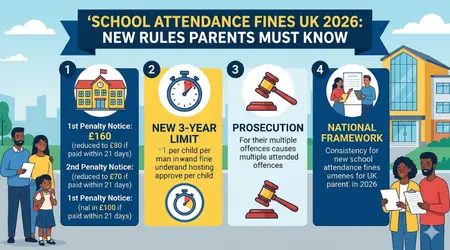
One detail that is often ignored in the headlines is the “revolving door” policy.
Under the School attendance fines UK 2026 rules, the fine for an unauthorised absence (such as a holiday) starts at £160 per parent, per child.
If paid within 21 days, this is reduced to £80. However, if you are caught again within a three-year rolling period, the fine automatically doubles to £160 with no “early bird” discount.
This is a deliberate move to stop wealthy families from simply treating the fine as a “surcharge” for a cheaper holiday.
By the time you reach a third offence within that three-year window, the local authority is legally mandated to consider alternative measures.
This often skips the fine entirely and moves straight to a “Parenting Order” or an Education Supervision Order. In extreme cases, it leads to a summons to the Magistrates’ Court.
My recommendation for you is to keep a meticulous log of any communication with the school.
If your child is genuinely ill, ensure you have medical evidence, as the threshold for what constitutes an “authorised” medical absence has also been tightened significantly in 2026.
What are the legal complexities of “Unauthorised Absence”?
The term “unauthorised” is the most contentious part of the new legislation.
It is a common misconception that parents have a “right” to ten days of holiday; this has never been the case.
In 2026, the DfE has issued updated guidance to headteachers, making it clear that “exceptional circumstances” must be truly exceptional think of the funeral of an immediate family member or a unique religious observance.
A discounted trip to Disney World, unfortunately, does not make the cut in the eyes of the law.
The legal framework surrounding School attendance fines UK 2026 is incredibly complex.
For instance, if you are a separated parent and your ex-partner takes the child on holiday without your consent during their time, you could still be liable for a fine if you were deemed to have “failed to ensure” the child’s attendance.
This has led to a surge in legal disputes between co-parents.
If you find yourself in this situation, consulting a family law specialist is often necessary, as the education department’s default position is to fine both individuals listed on the birth certificate regardless of living arrangements.
Comparison: Pre-2024 vs. 2026 Attendance Rules
| Feature | Pre-2024 Rules | 2026 National Rules | Parental Impact |
| Fine Amount | £60 (if paid early) / £120 | £80 (if paid early) / £160 | 33% increase in base cost. |
| Discretion | High (Headteachers’ choice) | Low (National 5-day trigger) | Less room for negotiation. |
| Repeat Offences | Resets every year | 3-year rolling window | Long-term financial risk. |
| Data Sharing | Periodic/Manual | Real-time/Digital | Instant enforcement. |
| Cap on Fines | None (councils could keep fining) | Two fines per 3-year period | Third strike leads to court. |
Why is the government targeting “Friday Fines” and “Monday Misses”?
One of the most interesting aspects of the School attendance fines UK 2026 strategy is the focus on “marginal” absences.
The DfE’s data suggests that many parents add a Friday or a Monday to a bank holiday weekend to get a four-day break.
While this seems minor, the cumulative effect on a child’s learning sequence is substantial. The 2026 software used by local authorities is specifically designed to identify these patterns.
If a child consistently misses the same day of the week, it will trigger an “Attendance Support Plan” even if the total days haven’t hit the five-day limit.
In my analysis, this shift represents a move from “punishing holidays” to “monitoring habits.”
The analysis most experts agree on is that persistent minor absence is harder to catch but more damaging to a child’s routine.
If your child is struggling with “school refusal” or “school avoidance” due to anxiety, it is vital to get this documented by a GP or an Educational Psychologist immediately.
Without this formal documentation, the system will view these absences as “unauthorised,” and the automated fine process will begin regardless of the child’s mental state.
Also read: Free School Projects Scrapped to Fund SEND Support: The Real Story Behind the Policy Shift
Is the current fine system fit for purpose in 2026?
The short answer is that it is a blunt instrument. While the School attendance fines UK 2026 measures are designed to increase attendance, critics argue they disproportionately affect low-income families.
For a wealthy family, a £160 fine is a minor inconvenience; for a family on Universal Credit, it is a week’s worth of groceries. This has led to accusations that the DfE is effectively “criminalising poverty.”
There is also the “Bank of England” factor to consider; as the cost of living remains high, the financial pressure on parents is already at a breaking point.
Moreover, the “Bidding War” for holiday prices continues to drive the problem.
Until the government addresses the predatory pricing of travel companies during school holidays, parents will continue to feel tempted to break the rules.
The analysis mais honesta suggests that as long as a holiday in August costs £4,000 more than the same holiday in June, a £160 fine will remain an attractive “tax” for many.
We are seeing the consequences of a system that tries to change behaviour through punishment without addressing the underlying economic incentives that drive that behaviour in the first place.
Navigation Through the New Attendance Landscape
We must accept that the era of “negotiated absence” is largely over. Parents need to become more proactive in their relationship with the school’s attendance officer.
If you know a crisis is coming be it a family illness or a significant life event you must provide evidence upfront.
The 2026 system is designed to be automated, and once the “Section 444” process begins, it is very difficult to stop.
Understanding the rules is the first step in protecting your family from unnecessary legal and financial stress.
For those navigating the School attendance fines UK 2026 landscape, the path ahead requires transparency.
It involves a “partnership” with the school, even when that partnership feels one-sided.
However, by understanding the triggers from the 5-day national limit to the 3-year rolling window you can better plan your family time.
The ultimate goal is to keep children in the classroom, but in 2026, the government is using a very heavy stick to ensure that happens.
Navigating the Path Forward: A Final Reflection
The 2026 attendance rules represent a fundamental shift in the “social contract” between parents and the state.
We have moved from a system based on local trust to one based on national surveillance and automated enforcement.
While the intention is to improve educational outcomes, the execution feels increasingly punitive for families caught in the middle.
The challenge for parents in 2026 is to balance the undeniable value of classroom time with the increasingly difficult logistics of modern family life.
As we move forward, the “attendance battle” will likely be a defining feature of the UK education system.
Whether these fines actually improve GCSE results or simply increase the number of families in the court system remains to be seen.
What is certain, however, is that the days of the “sneaky week off” are officially behind us. Parents must now be as diligent with their child’s attendance records as they are with their own bank balances.
Frequently Asked Questions (FAQ)
Can I appeal a school attendance fine in 2026?
There is no formal right of appeal against a fixed penalty notice once it is issued. You can either pay it or choose not to pay, in which case the local authority will decide whether to prosecute you in court.
If you win at court, the fine is vacated, but if you lose, you could face a much larger fine and a criminal record.
Does the fine apply to each parent individually?
Yes. If two parents take two children on an unauthorised holiday, the local authority can issue four fines (one for each child, to each parent). In 2026, the total cost for a family of four could be £640 for a single first-time offence.
What counts as “Five Days” of absence?
The School attendance fines UK 2026 rules specify ten sessions of unauthorised absence.
Since schools have two sessions per day (morning and afternoon), this equates to five full school days. These days do not have to be consecutive; they can be spread across a ten-week period.
What happens if I refuse to pay the fine?
If the fine is not paid within 28 days, the local authority must either withdraw the notice or prosecute you under Section 444 of the Education Act 1996.
A conviction can result in a fine of up to £2,500, a community order, or even a prison sentence of up to three months.
Is home-schooling a way to avoid these fines?
Elective Home Education (EHE) is a legal right in the UK. However, you cannot simply “switch” to home-schooling for a week to go on holiday.
If you remove your child from the school roll, you take on full legal and financial responsibility for their education.
Councils in 2026 are also increasing “monitoring visits” to ensure home-schooling is not being used as a cover for truancy.
Do these rules apply to private and independent schools?
While independent schools have their own attendance policies, they are still required to notify the local authority about pupils with poor attendance.
However, the specific “National Framework” for fines primarily targets state-funded schools (including academies and free schools).
