
The New Era of Renting in the UK: The Impact of the Renters’ Rights Act

The British landscape of domestic life has undergone a tectonic shift. As of 1st May 2026, the private rented sector (PRS) in the United Kingdom entered a new epoch with the full implementation of the Renters’ Rights Act.
For decades, the power dynamic between landlords and tenants was defined by the looming shadow of Section 21 the so-called “no-fault eviction” notice.
However, following years of legislative debate and advocacy from groups like Shelter UK and the Renters’ Reform Coalition, the government has finally overhauled the system to prioritise security of tenure and fairness.
This legislation arrives at a critical juncture for the British economy.
With the impact of the Renters’ Rights Act beginning to permeate every corner of the housing market, from London’s high-pressure boroughs to the growing rental hubs of Manchester and Birmingham, understanding the nuances of these changes is no longer optional.
It is essential for financial survival and domestic stability.
This article provides an authoritative deep dive into the new legal framework, offering a critical analysis of how the 2026 reforms reshape the rights, responsibilities, and economic realities of renting in the UK today.
Contents
- The Abolition of Section 21: A New Era of Security
- Ending Rental Bidding Wars: Transparency in Pricing
- Caps on Advance Rent: Protecting Tenant Liquidity
- The Legal Right to Pets: Balancing Welfare and Liability
- The Decent Homes Standard: Enforcing Quality in the Private Sector
- Economic Outlook: Market Reactions and Future Predictions
- Conclusion: Navigating the Transition
- Frequently Asked Questions (FAQ)
The Abolition of Section 21: A New Era of Security
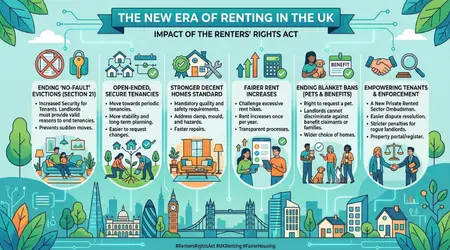
The most significant impact of the Renters’ Rights Act is undoubtedly the total abolition of Section 21 evictions.
Under the previous Housing Act 1988, landlords could regain possession of their property at the end of a fixed-term tenancy without providing any reason, simply by serving a two-month notice.
This created a culture of “revenge evictions,” where tenants feared reporting damp, mould, or broken boilers for fear of being asked to leave.
As of May 2026, all tenancies have transitioned to a single system of periodic tenancies, meaning they roll from month to month with no end date unless the tenant chooses to leave or the landlord has a valid, evidence-based reason to end the agreement.
Under the new Section 8 grounds, landlords must now prove specific circumstances to the court, such as significant rent arrears, antisocial behaviour, or a genuine intent to sell the property or move back into it themselves.
While some critics argue this makes the market less flexible for investors, the GOV.UK guidance emphasises that these measures are vital for mental health and community cohesion.
For the first time in nearly forty years, a tenant who pays their rent and looks after their home can plan their future choosing schools for their children or investing in local community ties without the arbitrary threat of being uprooted.
++ Keir Starmer approval rating 2026: why support is falling fast
Ending Rental Bidding Wars: Transparency in Pricing
For years, prospective tenants in competitive markets faced the harrowing experience of “bidding wars,” where they were encouraged to offer hundreds of pounds above the asking price just to secure a viewing.
The impact of the Renters’ Rights Act has made this practice illegal. Landlords and letting agents are now prohibited from inviting or accepting offers that exceed the advertised rental price.
This move aims to bring a level of dignity and predictability back to the process of finding a home, ensuring that the price listed on portals like Rightmove or Zoopla is the price the tenant will actually pay.
From a specialist perspective, this change is designed to curb the artificial inflation of rental yields.
When agents can no longer pit desperate families against one another, the market is forced to settle at a more organic equilibrium based on local demand and property quality.
While this may lead to a slight initial increase in “sticker prices” as landlords attempt to find the ceiling of the market, it eliminates the hidden costs and emotional distress associated with the previous “blind auction” style of renting.
Transparency is now a legal requirement, backed by significant fines for those who attempt to bypass the regulations.
Caps on Advance Rent: Protecting Tenant Liquidity
One of the more predatory trends in the pre-2026 market was the demand for massive upfront payments.
It was not uncommon for international students or individuals without a UK-based guarantor to be asked for six or even twelve months of rent in advance.
This created a massive barrier to entry for many hardworking residents.
A crucial impact of the Renters’ Rights Act is the introduction of a legal cap on advance rent, strictly limiting it to no more than one month’s rent in addition to the standard five-week security deposit.
This policy shift, supported by data from the Bank of England regarding household liquidity and savings, ensures that tenants are not stripped of their emergency funds before they even move in.
For landlords, this requires a more robust approach to referencing and a greater reliance on rent guarantee insurance rather than holding large sums of the tenant’s capital.
By capping these payments, the government has effectively democratised access to the private rented sector, ensuring that mobility the ability to move for work or education is not restricted to those with substantial cash reserves.
Also read: Biggest Overhaul of UK Migration Model in 50 Years
The Legal Right to Pets: Balancing Welfare and Liability
The emotional impact of the Renters’ Rights Act is perhaps most visible in the new “Right to Request a Pet” clause.
Previously, “no pets” was the default setting for the vast majority of UK tenancies, leading to thousands of animals being surrendered to shelters annually.
Under the 2026 regulations, a landlord cannot unreasonably refuse a tenant’s request to keep a pet.
If a landlord denies the request, they must provide a written justification within 42 days, and the tenant has the right to challenge this via a new private rented sector ombudsman.
To protect property owners, the Act concurrently amended the Tenant Fees Act 2019 to allow landlords to require pet insurance.
This provides a balanced middle ground: tenants enjoy the companionship of an animal, while landlords have the security of knowing that any potential damage to carpets or fixtures is covered by a dedicated policy.
This reflects a more modern understanding of the “home” not merely as a financial asset for the landlord, but as a place of wellbeing for the occupant.
Specialist observers note that this change aligns the UK more closely with European rental standards, where pet ownership is a standard right for renters.
The Decent Homes Standard: Enforcing Quality in the Private Sector
Quality control has long been the Achilles’ heel of the British rental market. While the social housing sector has been subject to the Decent Homes Standard for years, the private sector remained a “wild west” of varying conditions.
The impact of the Renters’ Rights Act changes this by extending these stringent quality requirements to all private rentals.
Landlords are now legally obligated to ensure their properties are free from serious health and safety hazards, including “Category 1” hazards like severe damp, mould, and faulty wiring.
The enforcement of this standard is backed by local authorities, who now have greater powers to issue fines and rent repayment orders.
For tenants, this means a “legal floor” for what constitutes a habitable home. This isn’t just about aesthetics; it is a public health necessity.
Reports from the Resolution Foundation have frequently highlighted how poor-quality housing contributes to respiratory issues and increased costs for the NHS.
By mandating a minimum standard, the 2026 Act ensures that the PRS contributes to a healthier, more productive society.
It also rewards “good” landlords who already maintain their properties, by removing the competitive advantage previously held by “slum landlords” who cut corners.
Read more: Brit Awards 2026 Moves to Manchester: Cultural and Economic Impact Outside London
Economic Outlook: Market Reactions and Future Predictions
The broader economic impact of the Renters’ Rights Act is a subject of intense scrutiny by the OECD and the FMI (IMF).
In the immediate aftermath of the May 2026 implementation, we have seen a period of market recalibration.
Some smaller-scale landlords, particularly those who relied on the ease of Section 21 to manage difficult properties, have chosen to exit the market.
This has led to a slight increase in properties for sale in some regions, providing a modest window of opportunity for first-time buyers.
However, institutional “Build to Rent” investors have largely welcomed the changes, as they prefer long-term, stable tenancies over high turnover.
| Feature | Pre-May 2026 System | Post-May 2026 (Renters’ Rights Act) |
| Eviction Notice | Section 21 (No-fault) allowed | Section 8 (Grounds-based) only |
| Bidding Wars | Common in high-demand areas | Prohibited by law |
| Upfront Rent | Unlimited (often 6-12 months) | Capped at 1 month |
| Pets | Landlord’s discretion (usually “No”) | Legal right to request (with insurance) |
| Standards | Minimal (HHSRS only) | Mandatory Decent Homes Standard |
Current forecasts suggest that while rental prices may remain high due to an overall shortage of supply, the rate of increase is expected to stabilise as the “bidding war” premium is removed.
Investors are now looking at the UK rental market as a “yield play” focused on quality and longevity rather than quick turnover.
For the average tenant, the 2026 reforms represent a significant increase in “consumer power,” treating the rental agreement more like a professional service contract than a feudal arrangement.
A Balanced Path Forward
The impact of the Renters’ Rights Act marks the most significant social reform in British housing for a generation.
By removing the fear of arbitrary eviction and curbing unfair financial practices, the UK government has moved towards a more sustainable and equitable model of living.
While the transition may present challenges particularly for landlords adjusting to new administrative burdens and for courts dealing with a potential rise in Section 8 hearings the long-term benefits of a secure, high-quality rental sector are undeniable.
For those currently navigating the market, it is vital to be aware of these new protections.
If you are asked to pay more than one month’s rent in advance or if you are served a notice without a clear legal ground, you should seek advice from Citizens Advice or a qualified legal professional specialising in property law.
The “New Era of Renting” is here, and it is built on the pillars of transparency, quality, and security.
Frequently Asked Questions (FAQ)
Can my landlord still evict me if they want to sell the property?
Yes, but the process has changed. Under the impact of the Renters’ Rights Act, a landlord can evict you if they genuinely intend to sell the property or move in themselves.
However, they cannot use this ground within the first six months of a tenancy, and they must provide a mandatory notice period (usually four months). They must also provide evidence of their intent to sell if challenged.
Does this law apply to existing tenancies or only new ones?
As of 1st May 2026, the Act applies to all tenancies. There was a transition period for existing agreements, but all private residential tenancies have now been converted to the new periodic system.
Your old “fixed-term” contract effectively no longer exists in its previous form; you now have a rolling tenancy with the new legal protections.
What should I do if my landlord asks for 6 months’ rent in advance?
You should politely decline and point them toward the Renters’ Rights Act 2026. It is now illegal for a landlord or agent to demand or accept more than one month’s rent in advance.
If they insist, you can report them to your local council’s Trading Standards department or the new Private Rented Sector Landlord Ombudsman.
How does the “Right to Pets” work if I live in a flat with a head lease?
This is a complex area. If the landlord’s own lease (the head lease) strictly prohibits pets, they may have a “reasonable” ground to refuse your request.
However, the government is encouraging freeholders to modernise these leases to reflect the new national standards. Always check your specific agreement and ask for the refusal in writing.
Will these changes make my rent go up?
The law does not implement rent caps (except for advance payments). Landlords can still increase rent once a year to market rates using the Section 13 notice process.
However, because “bidding wars” are banned, the artificial “spikes” in rent caused by desperation should decrease, leading to more predictable pricing across the sector.
