
UK side hustle taxes 2026: when extra income must be declared

Navigating the world of casual earning can be incredibly rewarding, whether you are flipping vintage clothes online, driving for a ride-sharing app, or offering freelance graphic design on the weekend.
However, as the extra income rolls in, it is easy to forget that His Majesty’s Revenue and Customs (HMRC) is keeping a close eye on these digital footprints.
Following recent data-sharing regulations that require online platforms to report seller earnings directly to the tax authorities, understanding UK side hustle taxes 2026 has become more critical than ever for casual earners across the country.
Many people mistakenly believe that casual earnings are automatically tax-free, or that HMRC only cares about full-time businesses.
This misconception can lead to unexpected tax bills, penalties, and a significant amount of stress.
This comprehensive guide will break down exactly when your secondary income transitions from a hobby into a taxable activity, how to utilise available allowances, and how to stay fully compliant with the law.
Key Takeaways
Before diving into the legal definitions, here is a quick overview of what this guide covers:
- The legal distinction between a hobby and a trade under HMRC guidelines.
- How the £1,000 Trading Allowance protects casual earners.
- The shift in platform reporting rules and what it means for your privacy.
- A step-by-step breakdown of your registration and reporting deadlines.
The Legal Boundary: Hobby vs. Trading
The core of the issue lies in how HMRC defines your activity. The tax office uses a framework known as the “Badges of Trade” to determine whether you are simply enjoying a hobby or running a business.
If you create hand-knitted scarves once a year to gift to friends and sell a few leftovers online to cover the cost of yarn, you are likely enjoying a hobby.
However, if you actively purchase wholesale wool, market your products on social media, and sell them via e-commerce platforms with the clear intention of making a profit, HMRC views this as trading.
The frequency of your transactions, the organization of your activity, and your profit-seeking intent are the primary factors that shift the legal scale toward a taxable venture.
Understanding this distinction is vital because once your activity is classified as trading, you fall squarely under the rules governing UK side hustle taxes 2026.
Even if your primary source of income is a traditional PAYE (Pay As You Earn) job where tax is deducted automatically by your employer, you are personally responsible for assessing, declaring, and paying tax on any secondary trading income that exceeds government thresholds.
++ UK remortgage payments jump: how homeowners are coping
The £1,000 Trading Allowance Explained
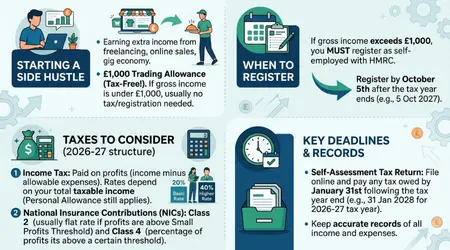
Fortunately, the government provides a tax-free buffer designed specifically to keep casual, low-income side hustles out of the self-assessment system.
This is known as the Trading Allowance. Under this rule, you can earn up to £1,000 in gross income (total sales before deducting any expenses) from your side hustles within a single tax year without needing to declare it to HMRC or pay any tax on it.
It is crucial to emphasize that this allowance tracks gross income, not profit. If you sell £1,100 worth of goods online but spent £400 on materials and shipping, your profit is only £700.
However, because your gross income crossed the £1,000 threshold, you have technically breached the allowance limit.
In this scenario, you are legally required to register for Self Assessment and report your earnings, even though your actual take-home profit was relatively small.
When it comes to calculating your UK side hustle taxes 2026, crossing this threshold gives you two distinct options for how you calculate your taxable income.
You can either deduct the flat £1,000 Trading Allowance from your gross income, or you can deduct your actual, calculated business expenses.
If your real expenses are lower than £1,000, claiming the flat allowance is highly advantageous as it artificially reduces your taxable profit, leaving more money in your pocket.
Platform Reporting and the Modern Tax Landscape
The landscape of secondary earning shifted dramatically when the UK implemented model reporting rules developed by the OECD.
Under these regulations, popular digital platforms ranging from Vinted and eBay to Airbnb, Deliveroo, and Upwork are legally mandated to collect data on seller transactions and report them directly to HMRC.
This means that the tax authorities have an automated, direct window into your secondary income streams.
These digital platforms are required to report your data if you make more than 30 sales or earn over roughly £1,700 (€2,000) in a calendar year.
This automated data-sharing eliminates the old assumption that small, casual online sales can easily go unnoticed.
HMRC uses sophisticated data-matching software to cross-reference these platform reports against individual tax returns.
If the automated system flags a discrepancy such as an individual making substantial sales on an e-commerce platform without a corresponding Self Assessment file it will automatically trigger an inquiry or a nudge letter.
Therefore, proactively managing your UK side hustle taxes 2026 is no longer optional for anyone crossing the basic thresholds.
It is worth noting that selling your own unwanted personal possessions, like clearing out your old wardrobe or selling a used mobile phone, generally does not count as trading.
HMRC is specifically targeting individuals who buy items with the intent to resell them for profit, or those providing ongoing freelance services.
When and How Must You Declare Extra Income?
If your gross secondary income exceeds the £1,000 threshold between 6 April 2025 and 5 April 2026, you must register as a sole trader with HMRC.
The absolute deadline for this registration is 5 October 2026. Failing to register by this date can result in failure-to-notify penalties, even if you eventually pay the tax you owe on time.
Once registered, you will need to file a Self Assessment tax return online. The final deadline for filing your digital return and paying any tax owed for the 2025/2026 tax year is 31 January 2027.
When filing, your side hustle income will be combined with your primary PAYE salary to determine your overall tax band, which could be 20%, 40%, or 45% depending on your total annual earnings.
| Feature / Metric | Hobbyist Status | Sole Trader Status |
| Gross Income Limit | Up to £1,000 per tax year | Exceeds £1,000 per tax year |
| HMRC Registration | Not required | Required by 5 October |
| Tax Return Filing | Not required | Required by 31 January online |
| Expense Deductions | Not applicable | Choice of £1,000 flat or actual expenses |
| Data Platform Reporting | Shared if over 30 items or ~£1,700 | Shared automatically by platforms |
Keeping flawless financial records throughout the year is the best way to prevent stressful surprises when January approaches.
You should maintain a dedicated spreadsheet or use basic accounting software to track every single payment received, along with digital copies of receipts for any business-related expenses.
Practical Examples of Side Hustle Taxation
To ground these rules in reality, let us look at two distinct everyday scenarios that illustrate how HMRC views different levels of casual income.
The Casual Freelancer
Sarah is a full-time marketing executive earning £35,000 a year under PAYE. In her spare time, she takes on occasional freelance copywriting jobs through online platforms.
Over the course of the tax year, she generates a total gross income of £850 from these projects.
Because her total gross earnings remain under the £1,000 threshold, she does not need to report this to HMRC or pay any tax on it. It is entirely covered by her Trading Allowance.
Also read: UK Households Cut Spending at Fastest Pace in Years — Financial Strategies for Tight Budgets
The Online Reseller
Tom works as a teacher and decides to start flipping electronic goods on eBay. He buys broken smartphones, repairs them at home, and resells them.
Over the tax year, his gross sales reach £3,400. He spent £1,200 buying the broken phones and £200 on shipping supplies, making his actual expenses £1,400.
Because Tom’s gross income easily surpassed £1,000, he must register for Self Assessment to handle his UK side hustle taxes 2026 liabilities.
Since his actual expenses (£1,400) are higher than the flat £1,000 Trading Allowance, he will choose to deduct his real expenses.
This leaves him with a taxable profit of £2,000 (£3,400 gross minus £1,400 expenses), which will be taxed at his standard income tax rate.
Read more: Later-Life Lending Surge: Why Over-55s Are Borrowing More and What It Means for Retirement Planning
Mastering Your Tax Obligations
Managing a secondary income stream is an excellent way to boost your financial resilience, build new professional skills, or transition a beloved hobby into a full-scale career.
However, true financial freedom requires staying on the right side of tax regulations.
With HMRC’s increasingly sophisticated data-sharing links with digital platforms, attempting to keep an active, profitable side business off the grid is a highly risky strategy that frequently results in costly penalties.
By understanding the clear boundary between a casual hobby and a commercial trade, monitoring your gross income against the £1,000 Trading Allowance, and keeping meticulous financial records, you can grow your venture with absolute peace of mind.
Tax compliance should not be viewed as an obstacle to your entrepreneurial spirit, but rather as a foundational step toward building a sustainable, legitimate business.
Frequently Asked Questions
Do I have to pay tax if I am already taxed via PAYE in my main job?
Yes. Your primary PAYE job only handles the tax owed on that specific salary.
Any extra trading income you earn independently that exceeds the £1,000 Trading Allowance is not covered by your employer’s payroll.
You must declare this extra income independently through a Self Assessment tax return, where it will be taxed based on your total combined annual income.
What happens if I fail to declare my side hustle income to HMRC?
If you cross the threshold and fail to declare your earnings, you could face automated penalty notices from HMRC.
These typically include financial penalties for failing to notify them of your trading status, interest on the unpaid tax backdated to the original due date, and potential behavioral penalties if they determine you deliberately concealed your income.
Can I claim the Trading Allowance if my business makes a net loss?
If your side hustle incurs a net loss (your business expenses are higher than your gross income) and you want to use that loss to offset other taxable income, you cannot use the Trading Allowance.
You must choose between claiming the flat £1,000 allowance or deducting your actual expenses. To claim a commercial loss, you must report your exact, actual figures through Self Assessment.
Does selling my old clothes on Vinted mean I am automatically taxed?
Generally, no. If you are simply clearing out your wardrobe and selling personal items for less than you originally paid for them, you are not trading for profit.
However, if you systematically source clothes from charity shops or wholesalers with the explicit intention of reselling them at a higher price to make a profit, HMRC will classify you as a trader subject to standard tax rules.
Where can I find official guidance to ensure I am fully compliant?
The definitive source for all UK tax regulations is the official GOV.UK website.
They offer interactive tools to help you check if you need to tell HMRC about your extra income, alongside detailed breakdowns of allowable business expenses.
For complex financial situations or high-volume earnings, consulting a certified Chartered Accountant is highly recommended.
