
UK benefit fraud checks increase 2026: what triggers investigations

The morning post for many households in the United Kingdom has taken on a more formal, perhaps slightly more daunting, tone in recent months.
As the Department for Work and Pensions (DWP) accelerates its digital transformation, the UK benefit fraud checks increase 2026 is becoming a tangible reality for millions of claimants.
I recently spoke with a former DWP compliance officer who noted that the “traditional” fraud investigation once triggered primarily by anonymous tip-offs or missed appointments has been entirely superseded by automated, data-driven “surveillance” that operates 24 hours a day.
The shift we are seeing in 2026 is not merely about “more” checks; it is about a fundamental change in how the state monitors the financial lives of its citizens.
With new legislative powers granted under the Public Authorities (Fraud, Error and Recovery) Act, the DWP now possesses the legal leverage to peer directly into bank accounts to verify eligibility.
For the honest claimant, this can feel like an intrusion; for the system, it is viewed as a necessary evolution to protect the £9.5 billion lost annually to overpayments and error.
Navigating the 2026 Compliance Landscape
- Data-Matching Revolution: How HMRC and DWP systems now communicate in real-time.
- The £16,000 Threshold: Why automated bank monitoring is the primary trigger for Universal Credit reviews.
- Algorithm-Driven Flags: Understanding the “Eligibility Verification Measure” (EVM).
- The Living-Together Trap: Why household composition remains the most complex area of investigation.
- Your Rights in 2026: What to do if you receive an Eligibility Verification Notice.
Why is the DWP increasing fraud checks so aggressively in 2026?
The primary driver behind the UK benefit fraud checks increase 2026 is the sheer scale of fiscal pressure on the Treasury.
According to the latest Public Accounts Committee reports, the DWP’s accounts have been “qualified” for nearly four decades due to unacceptable levels of fraud and error.
To combat this, the government has invested over £3.5 billion specifically into fraud-detection technology and a “strike force” of 3,000 additional investigative staff.
What many claimants fail to realise is that the DWP is no longer just looking for “criminals” in the traditional sense.
A significant portion of the current crackdown focuses on “claimant error” individuals who have unintentionally failed to report a change in circumstances.
By moving to a proactive digital model, the DWP aims to stop overpayments before they accumulate into life-altering debts.
However, the byproduct of this efficiency is a system that can feel cold, automated, and unforgiving to those who don’t keep their digital journals updated to the minute.
++ Universal Credit sanctions rules 2026: what claimants must know
What are the primary triggers for a fraud investigation today?
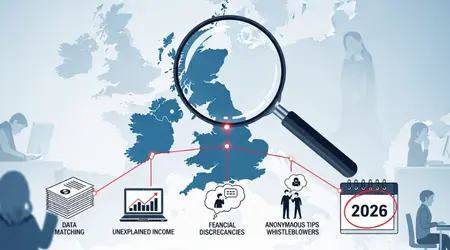
In 2026, the DWP utilizes an “Eligibility Verification Measure” (EVM) that acts as a digital tripwire.
Unlike previous years where an investigator had to have “reasonable suspicion” to request bank statements, the new law compels the UK’s top 15 banks to proactively flag accounts that meet certain criteria.
This automated flagging is the single biggest contributor to the UK benefit fraud checks increase 2026.
The most frequent trigger is the capital limit. For those on Universal Credit, having savings above £6,000 reduces your payment, and exceeding £16,000 eliminates eligibility entirely.
In the past, the DWP relied on self-reporting. Now, if a bank account linked to a benefit claim stays above these thresholds for a sustained period, an automated “red flag” is sent to the DWP.
This often results in a “Review of Claim” letter, which many people mistake for a standard update until they realize the depth of the information the department already possesses.
How does the “Living Together” rule trigger checks?
One of the most nuanced areas of the UK benefit fraud checks increase 2026 involves household composition.
The DWP’s algorithms now cross-reference address data from a variety of sources, including credit reference agencies, the DVLA, and local council tax records.
If a “single” claimant’s address is consistently linked to another adult perhaps through a car insurance policy or a mobile phone contract it can trigger an investigation into whether they are “living together as a married couple” (LTAHAW).
This is where expertise and experience are vital. The DWP doesn’t just look at who is at the door; they look at “financial entanglement.”
Joint bank accounts, shared utility bills, or even social media posts can be used as evidence.
If the system spots a pattern of financial co-dependence that hasn’t been declared, a compliance interview is almost certain to follow.
It is a highly invasive process that highlights why absolute transparency about who lives in your home is more critical now than ever before.
Also read: Council Budgets and Welfare Reform: How Local Authorities Are Preparing for New Benefit Pressures
The Role of Overseas Transactions
Another emerging trigger in the 2026 landscape is the “1-month rule.” Most means-tested benefits require you to be in the UK.
The DWP’s new data-sharing agreements with financial institutions allow them to spot sustained spending patterns abroad.
If your bank card is being used in Spain or Poland for six consecutive weeks, the system will flag a potential “residency violation.”
This is a stark reminder that in a digital economy, your location is rarely a secret from the authorities.
Fraud Detection Triggers: 2026 Comparison Table
| Trigger Type | How it is Detected | Threshold/Criteria | DWP Action |
| Capital Excess | Automatic Bank Feed | Over £6,000 or £16,000 | Eligibility Verification Notice |
| Undeclared Earnings | Real-Time HMRC Data | Discrepancy with Journal | Automatic Payment Adjustment |
| Household Linkage | Credit Agency Mapping | Two names at one address | Compliance Interview / Home Visit |
| Residancy Breach | Foreign Transaction Logs | Over 28 days abroad | Suspension of Claim |
| Lifestyle Mismatch | High-Value Spending | Outgoings exceed income | Comprehensive Fraud Enquiry |
How should you respond to an Eligibility Verification Notice?
If you are caught up in the UK benefit fraud checks increase 2026, you will likely receive an Eligibility Verification Notice.
This is a legal document, and ignoring it is the fastest way to have your payments suspended. My advice, based on years of observing the DWP’s internal processes, is to be meticulously organised.
You will be asked to provide evidence bank statements, tenancy agreements, or proof of identity often within a 14-day window.
It is important to understand that these notices are often “presumption-free.” The DWP claims they are not accusing you of fraud at this stage; they are “verifying entitlement.”
However, if the evidence you provide contradicts the data they already have from their banking partners, the case will escalate to the Fraud Investigation Service (FIS).
At this point, the tone changes, and you may be invited to an “Interview Under Caution.” If this happens, I strongly recommend seeking legal advice or contacting Citizens Advice immediately.
What are the legal consequences of benefit fraud in 2026?
The government has significantly toughened the penalties associated with the UK benefit fraud checks increase 2026.
Beyond the standard “Administrative Penalty” (a fine added to your debt), the DWP now has the power to recover overpayments directly from bank accounts or even earnings without a court order.
In more serious cases of deliberate “criminal” fraud, they can also pursue the suspension of driving licences or passports as a deterrent.
The “Trustworthiness” of the system depends on these powers being used proportionately.
However, as an analyst, I find the lack of a “judicial hurdle” for some of these recoveries to be a point of significant concern.
It places the burden of proof heavily on the claimant.
If the DWP makes an “official error” which they did to the tune of £1 billion last year the claimant may still find their funds seized while they are in the process of appealing the decision.
Read more: Scrapping the Work Capability Assessment by 2028: What That Means and What Comes Next
Common Myths vs. 2026 Realities
There is a common myth that “the DWP only checks you if someone reports you.” In 2026, this is dangerously incorrect.
While anonymous tips still play a role, the vast majority of checks are now “system-generated.” The algorithm doesn’t need a tip-off; it just needs a data discrepancy.
Another myth is that the DWP “can’t see your PayPal or Revolut.” Modern data-sharing legislation covers almost all electronic money institutions, not just high-street banks.
Conclusion: Navigating a More Vigilant System
The UK benefit fraud checks increase 2026 represents a turning point in the social contract. The DWP’s ability to monitor financial life in real-time has made the “Safety Net” feel more like a “Digital Web.”
For most people, the best defence against an investigation is a proactive approach to your Universal Credit journal. Every change no matter how small should be reported the day it happens.
Ultimately, while the technology is sophisticated, it is still prone to the “computer says no” errors that have plagued the DWP for decades.
If you find yourself the subject of an investigation, remain calm, provide clear evidence, and do not hesitate to challenge an incorrect decision through the Mandatory Reconsideration process.
Transparency is your greatest ally in a system that is now designed to see everything.
Frequently Asked Questions (FAQ)
Can the DWP see exactly what I buy in shops?
No. The current “Eligibility Verification” powers allow them to see account balances and the frequency of transactions, but they do not generally have access to individual line-item receipts unless a full criminal investigation is launched.
What happens if a family member gives me a cash gift?
If a gift pushes your total savings over the £6,000 threshold, you must report it. The DWP’s new bank checks will likely spot the large deposit.
You should keep a record of where the money came from to prove it isn’t “hidden income.”
Will the DWP check my social media accounts?
Yes, if an investigation is escalated. Fraud investigators often look at public social media profiles to see if a claimant’s lifestyle (e.g., luxury holidays) matches their declared income, or to verify if a “single” claimant is actually in a relationship.
Can I lose my benefits if I go on holiday?
You are generally allowed to go abroad for up to one month, but you must remain “available for work” if you are in an intensive work-search group.
If you fail to declare your absence and the DWP spots foreign transactions, it will trigger an investigation.
Does the DWP need a warrant to check my bank?
Under the 2026 legislation, they do not need an individual warrant for each check.
They issue “Eligibility Verification Notices” to banks, which are then legally required to provide the data automatically for all relevant accounts.
